Three clusters dominated the football news cycle in the last forty-eight hours. In each one, an African or MENA footballer did the decisive thing. In none of them was the story written as theirs.
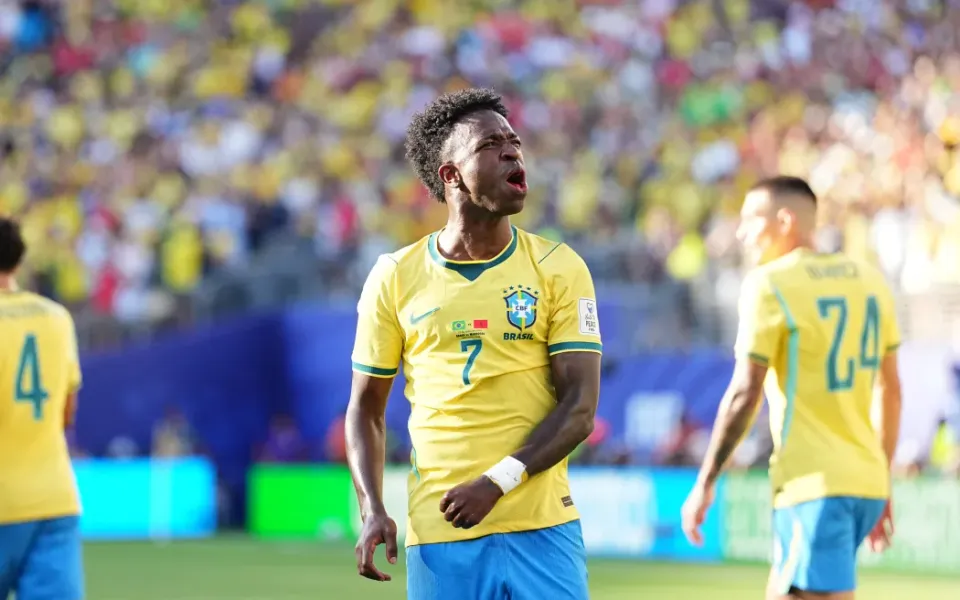
Start with the Brazil draw. Vinicius scored a solo goal that the English-language press has already decided was the event. Sky called it a stunner. The BBC ran the video as the lead and then ran a follow-up asking whether Vinicius had papered over Brazilian cracks. The headline subject is Brazil. The secondary subject is Vinicius. Morocco appears as the opponent, occasionally as enterprising, never as the protagonist of the ninety minutes. A five-time world champion was held to a draw by an African side in its opening group game, and the reading offered to English-reading audiences is that Brazil has problems. The framing is not wrong on its own terms. It is just not the only frame, and it is the only one being printed.
The Canada cluster is the cleanest example. FourFourTwo led with a goal-line clearance described as as good as a goal. The man who made it is named in the URL by his former club. Ex-Arsenal player. The piece is built around the clearance as an event, around Canada as the opponent, and around the Premier League past as the locator. The defender's national team, the years of his career that produced the reflex, the federation that called him up, all of this is treated as background. The headline asset is the Arsenal association. The body of the work is African.
Then Saibari. PSV's midfielder is, by FourFourTwo's framing, applying pressure on Bayern Munich to complete a big-money transfer. The verb is revealing. Saibari is doing the pressuring, which is to say the player has leverage, which is to say the player is the active party. The headline still belongs to Bayern's timeline. The structure of the sentence makes the Bundesliga the destination and the negotiation the story. Saibari's actual football, the reason any of this is happening, is the silent premise. A Moroccan international generating sufficient market gravity to bend a Bayern window is reduced to a procedural update about a German club's summer.
And then Diouf. L'Equipe ran a long-form interview with El-Hadji Diouf in which the Senegal forward says he wanted to be the phenomenon of the future. It is the kind of career retrospective that any former English Premier League player of comparable record would receive in English. It exists in French. The Anglophone press, which spent two decades writing about Diouf as a disciplinary problem rather than a footballer, has not produced an equivalent. The retrospective surfaces in the language of the country that signed him after England was done with him.
This is the pattern. It is not a conspiracy and it is not new. It is a sorting mechanism. African and MENA players are admitted into European coverage as inputs: the goal conceded, the clearance that saved a chance, the transfer that completes a German midfield, the disciplinary file. The player is the cause. The headline is the effect on someone else.
The Morocco draw is the case that should have made the pattern impossible to miss. Wahbi's side neutralized Brazil for long stretches at MetLife. The goal Brazil scored was a moment of individual genius against a defensive structure that did its job. A serious reading of the ninety minutes would name Morocco as the reason Brazil had to find a stunner at all. Instead, the verb is held. Brazil was held. The grammar puts Morocco in the object position, even on a night, Morocco did the work.
The coverage won't change because the tournament is good. It will change when someone insists, week after week, that the decisive actor is the subject of the sentence. Today, the decisive actors were African. The sentences were about somebody else.