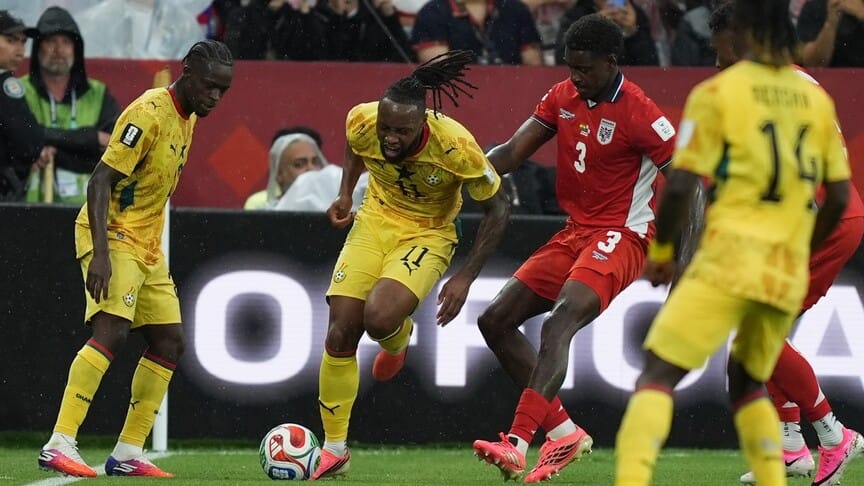
Ghana 1, Panama 0. Yirenkyi in the 95th minute. That is the scoreline and that is the sequence. Everything else around this match is interpretation.
The interpretation from the touchline is the one worth listening to. Antoine Semenyo, speaking after the win, said the victory had given the team the confidence and belief needed to face the greater challenges ahead. The framing matters because it is the right one. Ghana did not play well in Atlanta. They were thin in the final third, slow in the build-up, and visibly relieved when Yirenkyi's late goal went in. L'Équipe described it as a small miracle. That is not wrong, but it is also not the story.
The story is that Ghana now have three points from a match they could easily have drawn or lost, and a tournament structure that rewards exactly this kind of outcome.
This is the part of the World Cup the press tends to undercover. Opening-round wins by African sides are treated as narrative events, with the focus on the drama of the late goal or the surprise of the result. The structural fact is more boring and more important. In a 48-team tournament with a knockout pathway widened to a round of 32, three points in match one buys you a margin of error you cannot acquire any other way. A Ghana side that played at 60 percent of its capability and still won is a Ghana side that can lose the next match and still progress. That is not a moral judgment. That is the math of the new format.
Semenyo seems to understand this. His public message after the match was not triumphalist. It was procedural. The team has the points. The team has not yet played well. Both things are true. Both need to be true for the next two weeks to mean anything.
The Panama performance itself is worth one honest sentence. Ghana created very little in open play. The midfield struggled to connect with the forward line. Panama, who came into the match with reasonable hopes of a draw, were the better-organised side for long stretches and will feel they deserved something. They got nothing. Tournament football does this. A team plays well and goes home with zero. A team plays badly and walks out with three. The scoreboard is the only document the group stage reads.
What Semenyo is doing in the post-match interviews is something the better captains and senior players at this tournament have already started to do. He is managing expectations downward while the result manages them upward. The Ghanaian press, predictably, has begun talking about a deep run. The English-language coverage has picked up Yirenkyi's name. The work the team actually has to do, between now and the second group game, is to find a functioning attacking pattern. That work is not glamorous and it does not generate headlines. It is what determines whether the late goal in Atlanta becomes a footnote or a foundation.
There is a wider point here about how African campaigns at World Cups get narrated. The cycle is familiar. A late winner, a dramatic image, a wave of feature pieces about the underdog story, and then a heavier-than-expected loss in match two that gets framed as a return to form. The teams that break this cycle are the ones that treat the first result as data rather than as destiny. The pattern is not mystical. It is about whether the dressing room can hold two truths at once: we won, and we were not good.
Semenyo's approach does exactly that. The phrasing is careful. It refuses to convert the result into a prophecy. It keeps the bar where it should be.
Ghana's next match will tell the more important story. If they arrive at it with the same attacking shape they showed against Panama, the late winner will look like a borrowed point. If the coaching staff finds a way to get the front line connected to the midfield, three points in hand becomes a platform rather than an alibi. The squad has the players. The question is whether they can fix in four days what was visibly broken on Wednesday night.
The Black Stars have bought themselves the time to find out. That is what a 95th-minute goal in match one is for.
Semenyo is right. The team that wins the next match will be the one that understood what this first result was worth.