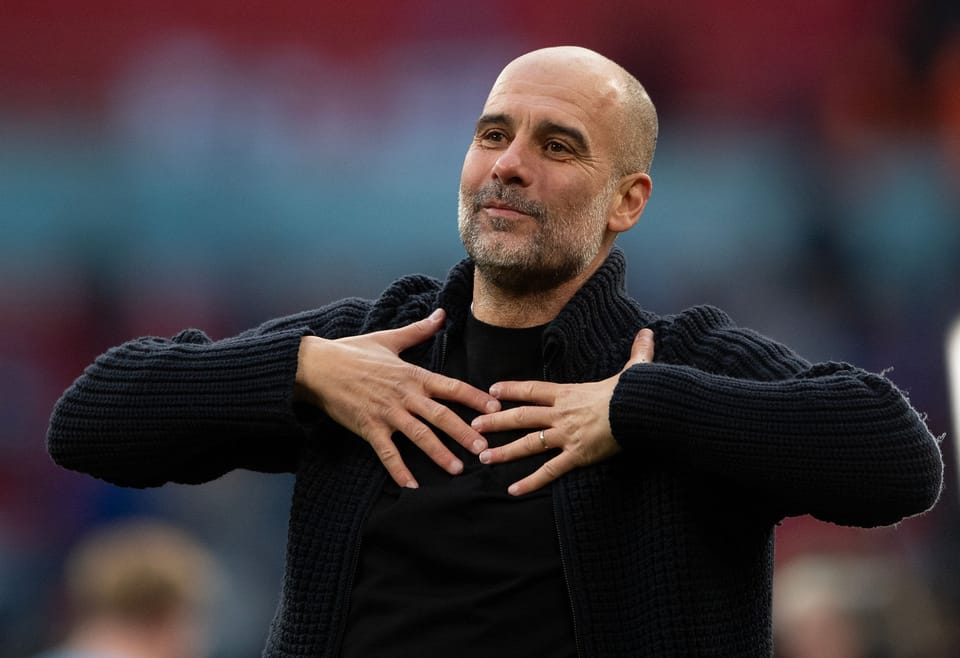
Pep Guardiola is reportedly leaving Manchester City this summer. The title was surrendered on Sunday. The story broke inside the same 24 hours. The framing arrived almost immediately, and the framing is the story worth following.
The English coverage has already organised itself around two reflexes. The first is elegiac: Guardiola changed the face of English football, the defining moments of six titles, the influence that will outlast the departure. The second is anxious: what does City do now, who replaces him, is it Maresca, is Rodri already gone, is Stones gone? Both reflexes are doing the same work. They are treating Guardiola as the load-bearing element of a decade of English football, and treating his departure as a structural rupture for the league rather than a personnel change at one club.
This has been the consistent reading throughout his time at City. The press did not cover Guardiola so much as it inhabited him. His press conferences were treated as text. His tactical shifts were treated as doctrine. His mood was treated as weather. When City won, the league was being elevated. When City lost, the league was being tested. The club itself, its ownership, its squad construction, its legal proceedings, all of it sat downstream of the manager as protagonist.
The departure exposes how much of that was a media arrangement rather than a football one.
Consider what the coverage is doing this week. Wayne Rooney says there is no way City are this successful without Guardiola. That is presented as analysis. It is closer to tautology. The squad that won six titles was assembled around the manager's specifications, at a cost the rest of the league could not match, inside an ownership project whose horizon is measured in decades rather than seasons. Removing the manager from that sentence does not remove the structure. It just removes the face of it.
The gossip pages have already moved to the next phase. Real Madrid are confident about Rodri. Bayern want Stones. The transfer-rumour register treats these as consequences of Guardiola leaving, as if the players signed for the man rather than the project. Some of them did. Most of them signed for the wages, the squad, the Champions League nights, and the institutional certainty that City would still be City in five years. That certainty has not changed this week. Only the manager has.
The succession conversation is where the framing breaks down most visibly. Is it Maresca next? The question is asked on Match of the Day as if City's hiring process is a Premier League parlour game, as if the club that built one of the most sophisticated football operations in Europe will be appointed by tabloid consensus. The city has a director of football. They have a recruitment structure. They have a stated philosophy that predates Guardiola and was, in fact, the reason Guardiola was hired in the first place. The next manager will be chosen to fit that philosophy. The English press will then spend two seasons measuring him against Guardiola and calling the gap a crisis.
There is a separate piece to write, one day, about what Guardiola actually did at City. The 100-point season. The treble. The way he rebuilt the full-back position twice. The way he changed how English coaches talk about possession without changing how most of them actually coach. That piece is available and worth writing. It is not what is being written this week.
What is being written this week is the same thing the press writes every time one of its protagonists exits. The departure is treated as an era ending. The replacement is treated as a referendum. The institution behind the protagonist is left mostly unexamined. This is the cycle. Ferguson's departure produced a decade of it at United. Wenger's departure produced a shorter version at Arsenal. Klopp's departure last year produced the compressed-to-six-months version at Liverpool. City's will be longer, because City's ownership has more patience than the press has memory.
The Premier League will continue to be shaped by the same forces that shaped it during Guardiola's tenure. Concentrated capital. Compressed competitive windows at the top. A small number of clubs operate on a different financial register from the rest. Guardiola was the most visible expression of that arrangement. He was not its cause.