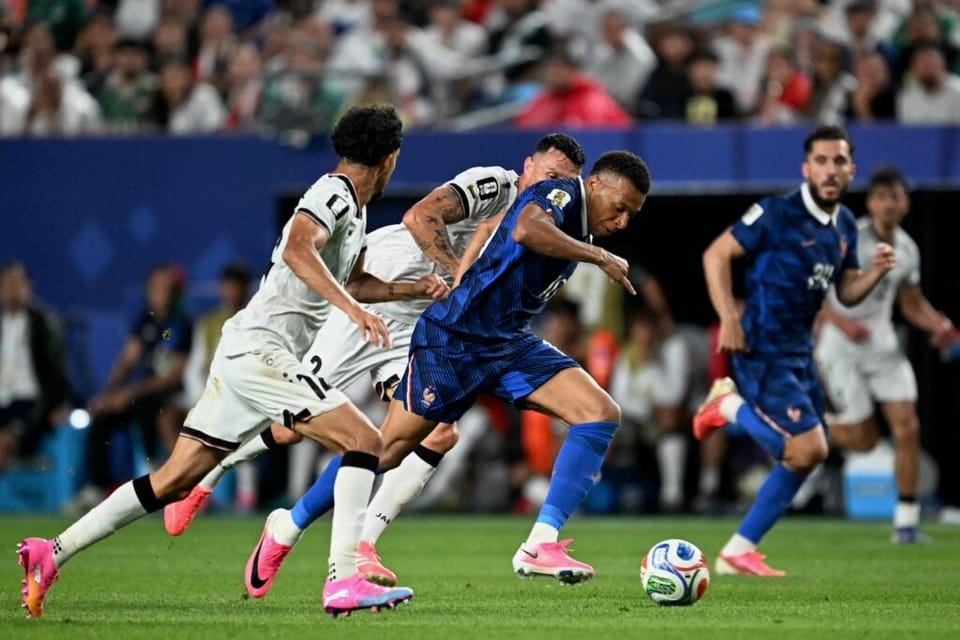
Joe Hart said it out loud. There is something up with the football.
He was on commentary when Kylian Mbappé struck from 25 yards against Iraq, the latest in a run of long-range goals where the keeper gets a hand to the ball and the ball goes in anyway. Hart's framing was specific. The Trionda, the official Adidas matchball for this tournament, is moving in a way that goalkeepers are reading late. He was a goalkeeper. He noticed.
The observation has barely entered the broadcast.
This is a Golden Boot race already being described as one of the best in memory. Messi has eighteen World Cup goals and now holds the all-time record outright. Mbappé is chasing him in real time, with the headline goal of the round coming from outside the box. Haaland has scored multiple doubles. Harry Kane is in the conversation. The strikers are scoring at a clip that the production is happy to package as a story about strikers.
It is also a story about the ball. The two stories are not in competition. They are layered.
The Trionda is the latest in a long line of World Cup matchballs that have provoked the same conversation. The Jabulani in 2010 was the most extreme example, and the discourse around it lasted the whole tournament. The Brazuca in 2014 was the corrective. Every cycle, Adidas presents a new panel structure, a new seam pattern, a new claim about flight stability, and every cycle, goalkeepers spend the group stage figuring out what is actually happening in the air. Hart is describing a known phenomenon at a new tournament, in real time, on a live broadcast, and it is sitting there for anyone who wants to pick it up.
The European press has so far chosen not to pick it up.
There is a reason for that, and it is not laziness. The Messi-breaks-the-record story is the cleanest story available. Klose's record fell in Dallas. Argentina are through to the last 32. Messi missed a penalty in the same game and scored from open play shortly afterwards, which means he also became the player who has taken and missed the most penalties in World Cup history. Two records in one half, one of them flattering, one of them human. Major outlets covered it extensively. FourFourTwo wrote multiple pieces around it on the same date.
A story about the matchball is harder. It implicates the manufacturer, the federation, the tournament organisers. It complicates the goal-of-the-tournament montage that broadcasters are already assembling. It introduces an asterisk into the Golden Boot race that nobody producing the coverage wants to introduce. A 25-yard Mbappé goal that the keeper got a hand to is a better clip if the goal is the only subject. The clip works less well if the commentary track is asking whether the keeper had a chance at all.
This is the kind of detail that gets noticed by the people who play the game and ignored by the people who narrate it. Hart said it because he used to face shots like that. The pundits who did not used to face shots like that moved on to the next talking point. The cost is not enormous. It is just specific. Goalkeepers across the tournament are being judged on saves they were never going to make, against a ball whose behaviour is part of the design.
None of this diminishes what Messi did against Austria. The eighteenth goal was a finish, not an accident. The Mbappé strike was struck cleanly. Haaland's doubles have come from positions where the ball did not need to do anything unusual. The strikers are not being given the goals. They are scoring them.
But the conditions are part of the reading, and the conditions are not neutral.
The pattern is recognisable from previous tournaments. A new ball arrives. The first week produces a cluster of long-range goals and a cluster of goalkeeper errors that are not really errors. The broadcasters celebrate the goals. A goalkeeper on co-commentary says something honest. The clip circulates for a day and is absorbed into the larger story, which is always the larger story: who scored, who lifted what, who is now the greatest. By the quarter-finals nobody is talking about the ball anymore. By the final the ball is invisible.
The ball is never invisible. It is the object the entire tournament is built around. Hart noticed because his job used to be noticing. The rest of the coverage has a story it would rather tell.
The Trionda will be talked about properly in four years, when the next ball arrives and people compare. That is the cycle. The cycle is itself the story.